 EN

Introduction
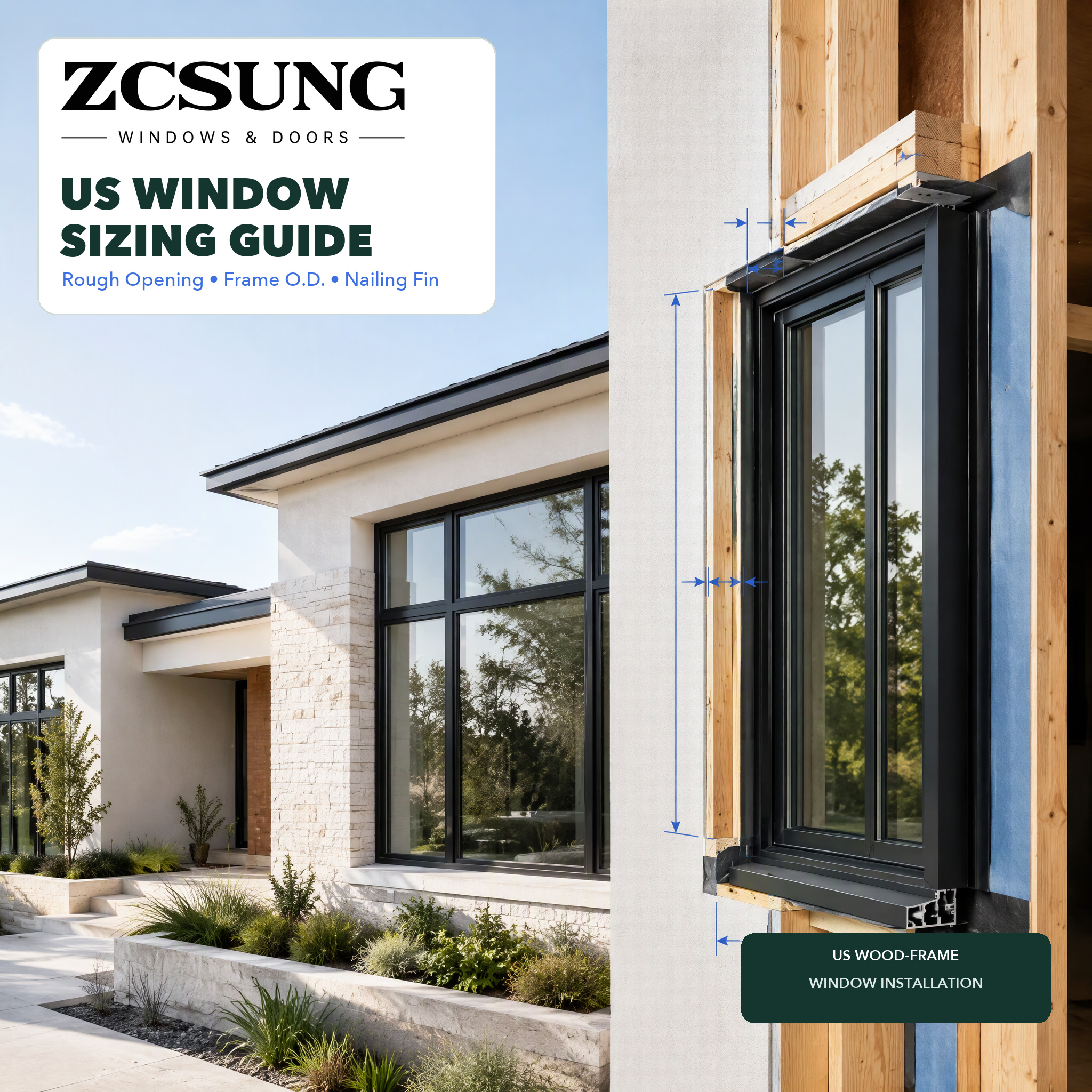
When ZCSUNG supplies thermal break aluminum windows to US residential builders and remodelers, size mismatch is the No.1 reason for order delays and on-site rejection. Many buyers simply convert millimeters to inches, but US window sizing logic is not just a unit conversion problem.
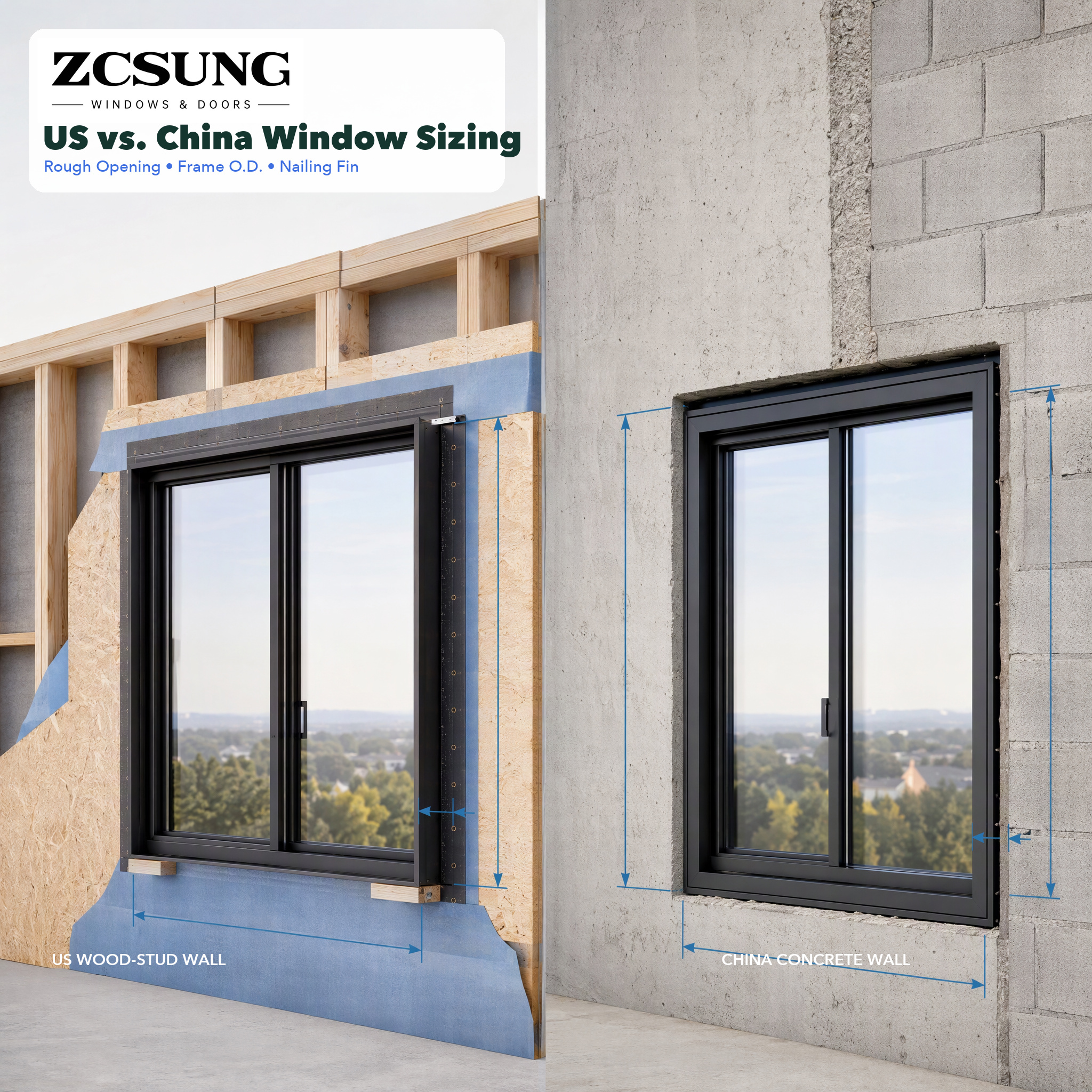
American window sizing is built around wood-frame construction, rough opening and IRC egress codes. Chinese window sizes follow GB/T 5824 metric modulus, designed for concrete masonry walls. Even if the mm-inch math matches, the frame, gap, flange and net opening may fail to fit US job sites.
All ZCSUNG aluminum windows can be manufactured to US nominal sizes, matched with IGCC and SGCC certified tempered insulated glass, nailing fin options and NFRC performance labeling for new construction and replacement projects.
1. Unit & Modulus Difference
✅ USA: Imperial system, unit = inch (1 inch = 25.4 mm). Modulus based on 2‑inch / 4‑inch increments; standard window sizes are formed by common lumber framing dimensions. US popular widths: 24”, 30”, 36”, 48”, 60”, 72”, 84” US popular heights: 36”, 48”, 60”, 72”
✅ China: Metric system, unit = millimeter (mm). GB/T 5824, basic modulus 100mm, common step 300mm. China popular 洞口 sizes: 900×1500mm, 1200×1500mm, 1500×1800mm, 1800×2100mm
Key note: China has standard series on paper, but most domestic projects are fully custom, no fixed stock sizes; US residential market relies heavily on stock nominal sizes for fast replacement.
2. US 4-Digit Nominal Code (Very Important for US Buyers)
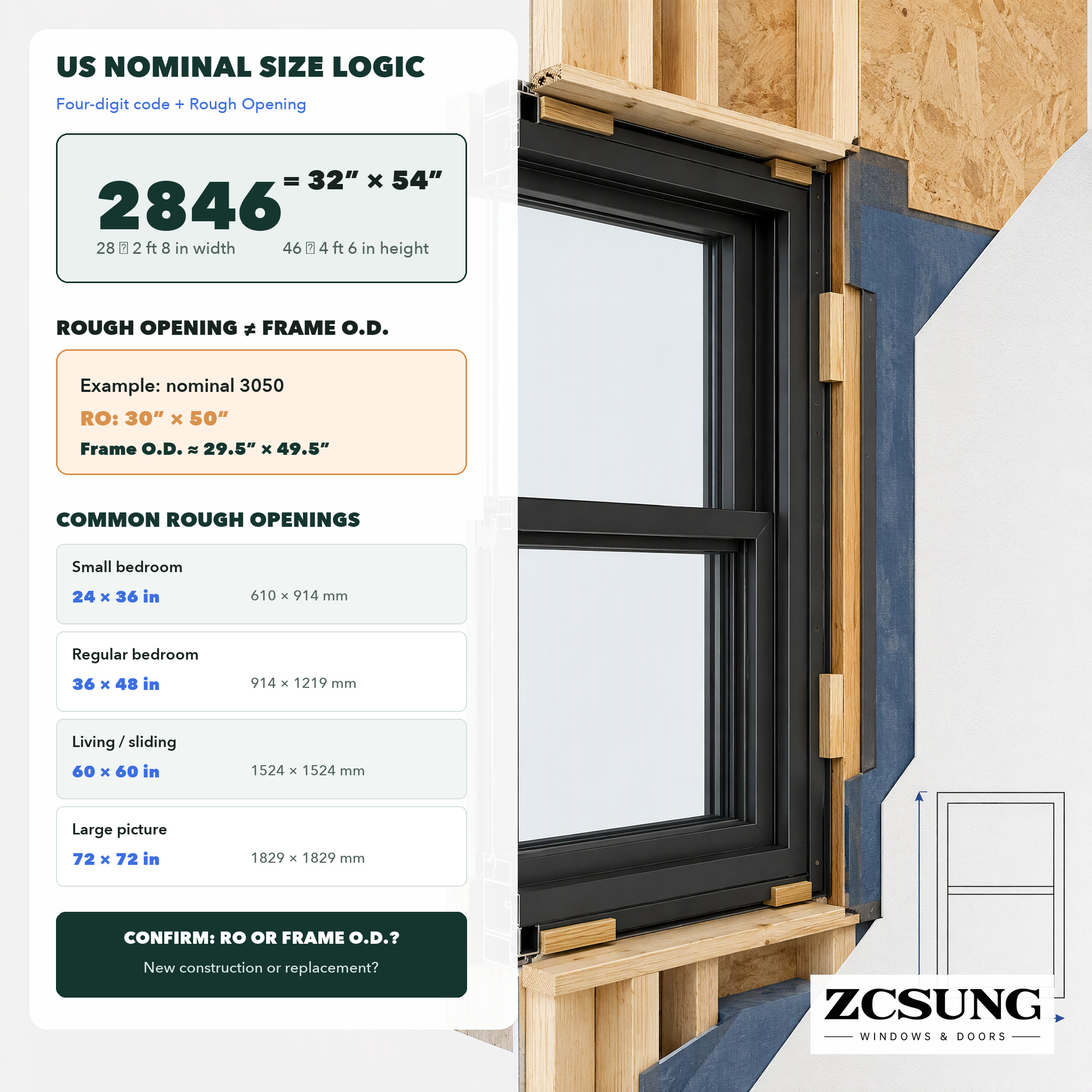
US double-hung / casement windows use 4-digit code, e.g. 2846
- First two digits: feet + inches for width → 28 = 2ft 8in (32”)
- Last two digits: feet + inches for height → 46 = 4ft 6in (54”) ⚠️ Critical: This 4-digit number is nominal rough opening, NOT the final frame outer dimension. Actual frame is about ½ inch smaller all around to leave shim gap. This is the most frequent misunderstanding between Chinese factories and US contractors.
3. Rough Opening vs Frame Size (Core Difference)
- US market: Drawings first list Rough Opening (RO) — the raw opening cut into wood stud wall. Frame O.D. (outer dimension) = Rough Opening minus 1/2” (12.7mm) for shimming, leveling and sealing gap. New construction windows come with nailing fin, sit on the exterior sheathing.
- China market: Drawings first list the finished frame outer dimension. The concrete hole is usually 10–20mm larger than frame for mortar filling. Almost no nailing fin for standard domestic windows; installation is set-in-wall style.
Example: US nominal 3050 window (30”w × 50”h RO) Frame OD ≈ 29.5” × 49.5” If you directly produce 30×50 inch frame, it will NOT fit the stud opening.
4. Common Standard Size Quick Comparison
| Scenario | US Nominal (Rough Opening) | Approx Metric | Typical Chinese Standard Opening |
|---|---|---|---|
| Small bedroom double-hung | 24×36 in | 610 × 914 mm | 600×900 mm |
| Regular bedroom window | 36×48 in | 914 × 1219 mm | 900×1200 mm |
| Living room picture / sliding | 60×60 in | 1524 × 1524 mm | 1500×1500 mm |
| Big fixed view window | 72×72 in | 1829 × 1829 mm | 1800×1800 mm |
You can see the numbers look close, but the 10–25mm gap accumulates and breaks installation.
5. Safety & Egress Dimension Codes
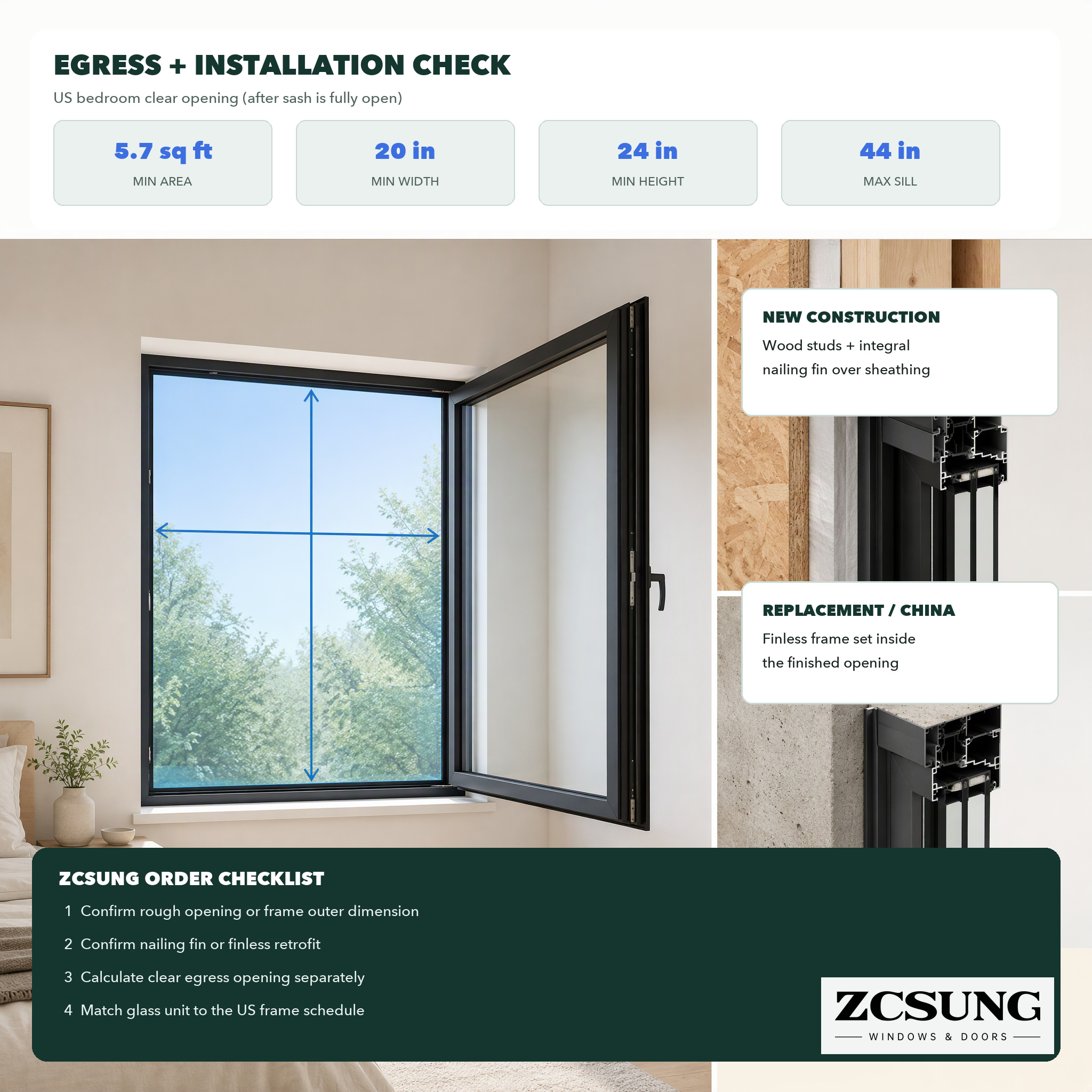
USA (IRC International Residential Code): Bedroom egress window requirement:
- Minimum clear opening area: 5.7 sq ft
- Minimum clear width: 20 in
- Minimum clear height: 24 in
- Sill height maximum 44 in above finished floor This is the net opening after sash fully opened, not frame size or rough opening.
? China (GB 55038-2025): No mandatory egress escape opening rule for bedrooms. Mandatory protection: sill height less than 900mm needs guardrail ≥900mm. Safety glass trigger: single pane 1.5㎡, glass bottom <500mm above floor.
6. Installation Interface: Nailing Fin Difference
This is a structural dimension difference, not just size:
- US new build aluminum windows: integral nailing fin (flange) extending outwards. Overall width & height of the whole product includes fin. Many Chinese factories forget to add fin width when quoting.
- China domestic aluminum windows: no nailing fin; frame outer size is only the profile itself, installed inside the wall opening. Replacement windows for US retrofit are finless, flush-fit style, different dimension rules again.
7. Practical Tips for ZCSUNG US Orders
- Always ask clients: Is this rough opening OR frame outer dimension? New construction (with nailing fin) or retrofit replacement?
- Do NOT only convert mm ↔ inch; confirm shim gap and nailing fin allowance.
- If client provides 4-digit Andersen / Jeld-Wen style code, cross-check RO first, then calculate frame OD.
- Egress check: calculate clear vent opening separately, especially for casement & double-hung.
- IGCC / SGCC glass unit sizes are also based on US frame schedule; glass cannot simply follow Chinese standard glass sizes.
FAQ
Q1: Can ZCSUNG produce windows to US rough opening sizes?
A1: Yes. Our thermal break aluminum window system supports custom RO-based sizing, nailing fin options, IGCC & SGCC certified insulated glass, Low‑E and argon gas fill.
Q2: If a customer gives 900×1500mm, can it directly replace US 36×60 window?
A2: No. 900mm≈35.4”, 1500mm≈59”. The dimension difference plus shim gap and nailing fin will cause fitting failure. We need to rework the schedule according to US RO.
Q3: What is the most common mistake Chinese suppliers make on US window sizing?
A3: Treat nominal size as frame outer size, omit nailing fin width, and ignore IRC egress net opening requirement.
Table of Contents
- Introduction
- 1. Unit & Modulus Difference
- 2. US 4-Digit Nominal Code (Very Important for US Buyers)
- 3. Rough Opening vs Frame Size (Core Difference)
- 4. Common Standard Size Quick Comparison
- 5. Safety & Egress Dimension Codes
- 6. Installation Interface: Nailing Fin Difference
- 7. Practical Tips for ZCSUNG US Orders
- FAQ